






My Basket : 0 article(s)

Welcome

My Basket

Order

My Account

Contact Us

General Sales Conditions

Quick Search
 
Advanced search


FLEX Catalogue
Collections
     EPSILON (8)
     RECREANOTES (29)
     GOSPEL (2)
Orchestras
     Wind Band (20)
     Jazz / Big-Band (4)
     Symphonic Orchestra (1)
Sound Library
     MP3 (30)
     CD (1)
Woodwinds
     Flute (23)
     Clarinet (62)
     Saxophone (10)
     Oboe (12)
     Bassoon (10)
Brass
     Quartet (7)
     Quintet (10)
     Sextet (1)
     Octet (1)
     Horn (26)
     Trumpet (24)
     Trombone (22)
     Tuba (21)
Misc. Ensembles
     Wind Quintet (2)
     Wind Octet (2)
     Vocal Ensembles (34)
     Other Ensembles (23)
Strings
     String Quartet (3)
     String Quintet (4)
     Violin (9)
     Viola (9)
     Cello (6)
     Contrabass (22)
     Harp (5)
Piano
Percussions


Newsletter

Your E-mail

Your name


Sondage
For which band types do you want you more pieces?
Wind Band and Symphonic Orchestra
Big-Band
Wind Ensembles (Flutes, Saxophones, Clarinets)
Wind Quintet
Brass Ensembles
Strings Ensembles
Piano
Vocal Ensembles

175 Votes
[ See the results ]
Welcome » DVORAK
Sort Articles by
Low to highHigh to low

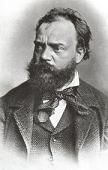
Antonín Dvořák (1841-1904)


Antonín Dvořák Antonín Leopold Dvořák (September 8, 1841 – May 1, 1904) was a Czech composer of romantic music, who employed the idioms and melodies of the folk music of his native Bohemia and Moravia in symphonic, oratorial, chamber and operatic works.

Dvořák was born on September 8, 1841 in Nelahozeves, near Prague (then Austrian Empire, today the Czech Republic), where he spent most of his life. His father was a butcher, innkeeper, and professional player of the zither. Dvořák's parents recognized his musical talent early, and he received his earliest musical education at the village school which he entered in 1847, age 6. He studied music in Prague's only Organ School at the end of the 1850s, and gradually developed into an accomplished player of the violin and the viola. Throughout the 1860s he played viola in the Bohemian Provisional Theater Orchestra, which from 1866 was conducted by Bedřich Smetana. The need to supplement his income by teaching left Dvořák with limited free time, and in 1871 he gave up playing in the orchestra in order to compose. During this time, Dvořák fell in love with one of his pupils and wrote a song cycle, Cypress Trees, in attempt to woo the heart of Josephina Čermakova. She married another man, however, and in 1873 Dvořák married her sister, Anna Čermakova. They had nine children.

At about this time Dvořák began to be recognized as a significant composer. He became organist at St. Adalbert's Church, Prague, and began a period of prolific composition. Dvořák composed his second string quintet in 1875, and in 1877, the critic Eduard Hanslick informed him that his music had attracted the attention of Johannes Brahms, whom he later befriended. Brahms contacted the musical publisher Simrock, who as a result commissioned Dvořák's Slavonic Dances. Published in 1878, these were an immediate success. Dvořák's Stabat Mater (1880) was performed abroad, and after a successful performance in London in 1883, Dvořák was invited to visit England where he appeared to great acclaim in 1884. His Symphony No. 7 was commissioned for London; it premiered there in 1885. In 1891 Dvořák received an honorary degree from Cambridge University, and his Requiem Mass premiered later that year in Birmingham at the Triennial Music Festival.

From 1892 to 1895, Dvořák was the director of the National Conservatory of Music in New York City. Here Dvořák met with Harry Burleigh, one of the earliest African-American composers, although Burleigh was never his pupil. Burleigh introduced traditional American Spirituals to Dvořák at the latter's request.

In the winter and spring of 1893, while in New York, Dvořák wrote his most popular work, the Symphony No.9, "From the New World". He spent the summer of 1893 with his family in the Czech-speaking community of Spillville, Iowa, to which some of his cousins had earlier immigrated. While there he composed two of his most famous chamber works, the String Quartet in F (the "American"), and the String Quintet in E flat, as well as a Sonatina for violin and piano.

Over the course of three months in 1895, Dvořák wrote his Cello Concerto in B minor, which was to become one of his most popular works. However, problems with Mrs. Thurber about his salary, together with increasing recognition in Europe — he had been made an honorary member of the Gesellschaft der Musikfreunde in Vienna — and homesickness made him decide to return to Bohemia. He left New York before the end of the spring term.

During his final years, Dvořák's compositional work centred on opera and chamber music. In 1896 he visited London for the last time to hear the premiere of his Cello Concerto. In 1897 his daughter married his pupil, the composer Josef Suk. Dvořák was director of the Conservatory in Prague from 1901 until his death in 1904. His 60th birthday was celebrated as a national event. He is interred in the Vyšehrad cemetery in Prague.

Wikipedia will allow you to know more about his biography and his Pieces.
 
COMING SOON AT FLEX EDITIONS
 
New transcriptions and arrangements of Antonín Dvořák's Pieces will be available soon. Some are listed here below.

Piece's Title Formation Arranger
Symphony No.9, "From the New World" Wind Band Bruno PETERSCHMITT


ALREADY AVAILABLE AT FLEX EDITIONS


Please find here below the transcriptions et arrangements of Antonín Dvořák's Pieces that are currently published by FLEX Editions.


DVORAK 
Humoresque No. 1 - A. DVORAK - Clarinet Quartet

  
 7.95 € VAT INCLUDED 
DVORAK 
Humoresque No. 2 - A. DVORAK - Clarinet Quartet

  
 7.95 € VAT INCLUDED 
DVORAK 
Humoresque No. 3 - A. DVORAK - Clarinet Quartet

  
 8.95 € VAT INCLUDED 
DVORAK 
Humoresque No. 4 - A. DVORAK - Clarinet Quartet

  
 7.95 € VAT INCLUDED 
DVORAK 
Humoresque No. 5 - A. DVORAK - Clarinet Quartet

  
 8.95 € VAT INCLUDED 
DVORAK 
Humoresque No. 6 - A. DVORAK - Clarinet Quartet

  
 7.95 € VAT INCLUDED 
DVORAK 
Humoresque No. 7 - A. DVORAK - Clarinet Quartet

  
 7.95 € VAT INCLUDED 
DVORAK 
Humoresque No. 8 - A. DVORAK - Clarinet Quartet

  
 8.95 € VAT INCLUDED 
Page(s):  1 
Composers


Multicriteria Search

Band Type

Duration

Level

Musical Style


Information - Help
  FLEX Engagement
  How to Order?
  Help - FAQ


Adverts


New Releases

The Barber of Seville : Overture - G. ROSSINI - Flute Quartet
16.95 € VAT INCLUDED


Most popular